High-Yield Bonds portfolio
Investing in bonds without the time commitment
- Automated investing and reinvestment
- Diversified across issuers and industries
- Initiate cash out anytime
- Average yield
- 8.51%
Mintos is a licensed investment platform for investing in bonds. Access high-yield bonds, typically reserved for institutional investors, from €50.

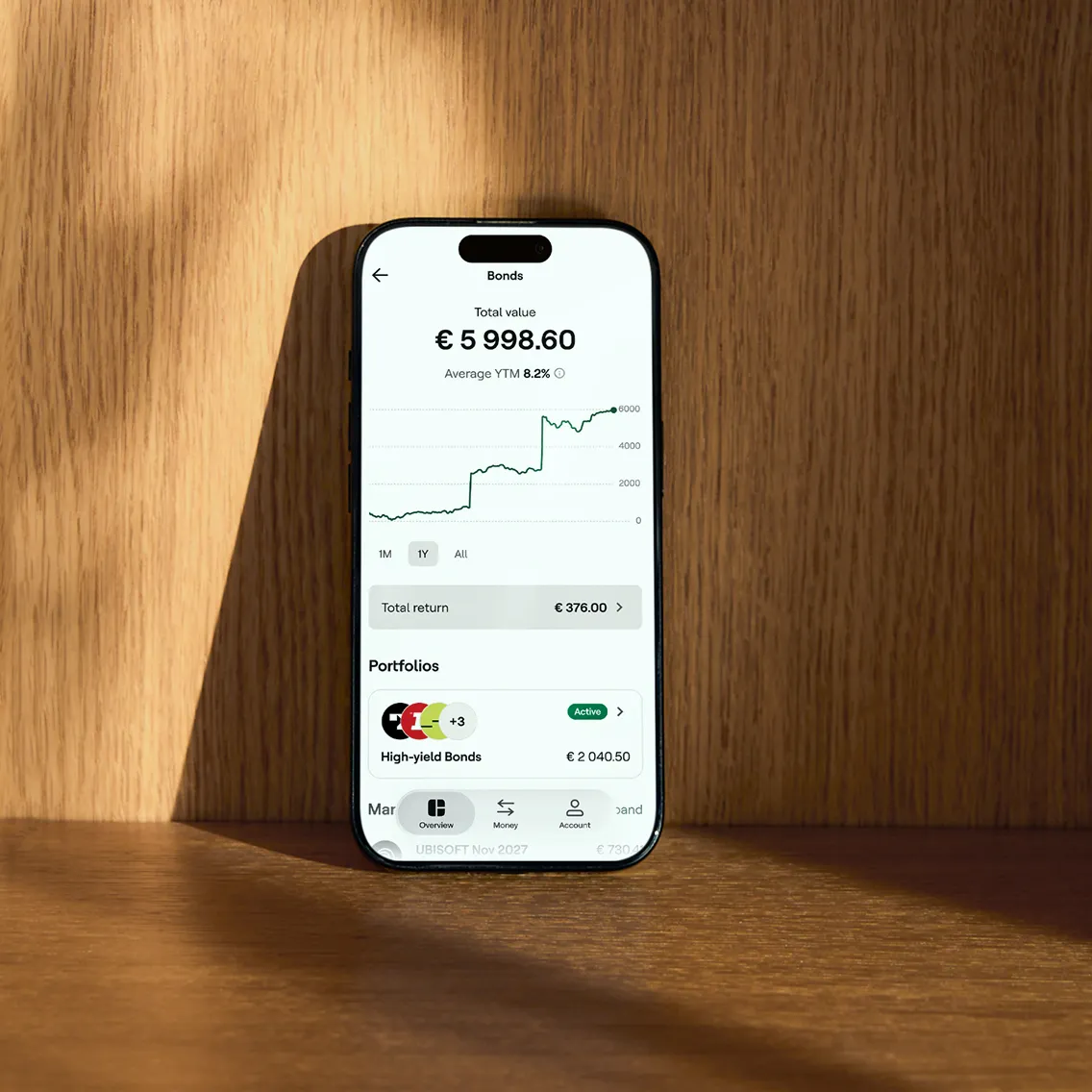
Investing in bonds on Mintos gives retail investors access to high-yield bonds from European issuers. Choose a fully automated portfolio or hand-pick individual bonds, starting from €50.
Investing in bonds without the time commitment
Hand-pick every bond you invest in.
Learn more about fees on Mintos.
Sell your individual bond investment before maturity on the Mintos Secondary Market or initiate cash out of your High-Yield Bonds portfolio anytime. Subject to market liquidity.

Bond returns come from scheduled coupon payments and repayment of the original investment at maturity. Yields reflect factors like issuer creditworthiness, time to maturity, and market conditions.

Diversify your investments across many asset classes to manage your risk and earn more stable returns.
Commission-free investing, 1 000+ ETFs from €1
No order, custody, inactivity, or withdrawal fees. Only an annual expense ratio built into each ETF's price.
Commission-free investing, 4 000+ stocks from €1
Regulated crypto investing via ETPs from €5
Fixed income with high-yield bonds, from €50
Manual or automated loan investing, from €50
Property-backed investment income, from €50
Earn up to 2.5% interest on your idle cash
Yield is subject to change in line with the interest rate environment.
Mintos makes bond investments accessible to retail investors. The vast majority of bonds require high minimum investments of €10 000 or more for a single nominal investment. Moreover, many bonds, especially high-yield ones, aren’t available to retail investors at all, as they are exclusively offered through private placements. This makes it difficult for many retail investors to build a diversified bond portfolio. On Mintos, we’re changing this: You can invest in small fractions of a bond, starting from just €50, and conveniently build a diversified bond portfolio.
Mintos offers 2 ways of investing in bonds:
Directly in a bond issued by a company or government entity. You own the bond or a fraction and receive coupon payments from the bond issuer.
Via bond-backed securities emitted by a special purpose entity within the Mintos group that acts as the issuer. The issuer holds the underlying bond, and passes its returns to you.
The return on a specific bond offer depends on the coupon (interest) rate. The coupon rate is determined by:
inherent risk factors of the bond, including the bond issuer’s creditworthiness
market factors, including the general economic environment, general interest rate levels, and alternative investment opportunities in the financial sector
If you hold your bond investment until maturity, fluctuations in the bond's value will not affect your return. However, if you want to sell your investment on the Mintos Secondary Market, the price might be affected by supply and demand, as well as changes in the risk and market factors. This means that the current value on the Secondary Market might vary from the original purchase price you paid.
If you already invest in another asset class such as stocks or ETFs, adding bonds to your portfolio can increase your overall diversification. This is because different asset classes often react differently to market changes. For example, bond and stock prices tend to move in opposite directions, hence adding bonds to your stock portfolio can soften the impact of a drop in the stock market.
Whether a bond is secured depends on the specific offer. You can read more about this in the applicable prospectus.
There are no fees for investing in individual bonds on Mintos.
The High-Yield Bonds portfolio has a portfolio management fee of 0.39% p.a. The fee is based on your portfolio's daily balance, is charged monthly, and will be deducted from your portfolio's cash. Learn more.
A bond is a debt security, or simply put, a form of “I owe you” (IOU) between a lender (the investor) and a borrower (the bond issuer). Bonds are commonly issued by a government, a government agency, or a company to finance projects or other needs.
In return for lending money to the bond issuer, the issuer promises to pay you a specified interest (or coupon) rate during the life of the bond, and the principal of the bond when it matures. A bond’s coupon rate can be either fixed or floating (quoted as a spread over a reference rate such as the Euribor). Hence they’re referred to as a type of fixed-income instrument.
Mintos primarily offers high-yield corporate bonds from European companies. Industries can include aviation, logistics, construction, consumer goods, electronics, energy, finance, and more.
Bonds, loans, and stocks are different investment types (a.k.a. asset classes). Each of these investments has its unique characteristics, including its risk and return, and how it makes you money.
When you invest in a stock, you buy small fractions of a company known as shares. If the company does consistently well, its value increases, and you can sell your shares for a financial gain. Of course, the opposite is also true.
When you invest in a bond, you lend money to the bond issuer, typically a government, government agency, or company. In return, the issuer agrees to pay you a specified interest rate (coupon) during the life of the bond, and the principal of the bond when it matures.
When you invest in a loan on a regulated platform like Mintos, you buy securities backed by loans issued by a lender to its borrowers. In return for your investment, the company issuing the loans agrees to pay interest and principal according to a defined repayment schedule.
The interest (or coupon) payment frequency depends on the bond. Common frequencies are monthly, quarterly, semi-anually, and annually. You can check the frequency for a specific bond in the bond details on Mintos or in the bond’s prospectus.
The main risks when investing in bonds include:
Risks related to the bond issuer: The company issuing the bond may become insolvent, unable to repay or refinance the bond at maturity, or stop cooperating with Mintos. As a result, the company could fail to honor its contractual obligations, leading to not making coupon or principal payments.
Market risk: The value of the bond may decline due to events outside the control of market participants, such as an economic downturn, a financial crisis, or geopolitical events.
Interest rate risk: Long-term fixed-interest securities such as bonds tend to react strongly to fluctuations in both short- and long-term interest rates.
Liquidity risk: Investors who want to sell their bond investment early can only do so on the Mintos Secondary Market. Mintos does not guarantee demand on the Secondary Market, nor availability of the Secondary Market as such.
You can read more about the risks in our risk disclosure.
Bonds can be a stabilizing force in your portfolio, helping you manage risk while still earning consistent returns. They could be interesting for you if the following goals resonate with you:
Regular income: Bonds provide scheduled interest payments, which can be a reliable income stream. This can be particularly useful for long-term planning or passive income goals.
Stability: Bonds typically offer fixed interest payments and return of principal at maturity, making them more predictable than stocks. This helps smooth out overall portfolio returns during times of market volatility.
Diversification: Adding bonds to your portfolio helps balance the risk of more volatile investments like stocks or crypto. They often behave differently in various market conditions.
Lower risk: Compared to stocks and loan-backed investments, bonds are generally considered lower risk.
It's the average price you paid for a bond across all your purchases. Each time you buy more of the same bond, the average updates to reflect your new total.
Why does it matter?
It tells you whether you're in a gain or a loss. If the current bond price is higher than your weighted average cost, you're in a gain. If it's lower, you're at a loss.
How is it calculated?
Total amount paid divided by the total face value you hold, shown as a percentage.
For example: You buy "ABCD" bonds three times, paying €4 090 in total for €4 000 in face value. Your weighted average cost is 102.25%.